
Webmaster Introduction: In an interview with Alex Jones (8/20/26), famous, ex-Special Forces veteran, Joe Biggs, mentioned that Task Force Orange and F3EA (find, fix, finish, exploit, assess) special forces groups are secretly targeting American citizens. Targets include Targeted Individuals (TIs), presumably.
Joe Biggs: They used the FISA courts to go against us (Jones, Biggs, Rhodes, and other J6 protestors and patriots). The FBI had me as one of the most wanted. I take that as a badge of honor. How many people out there can say that? When you know that the government’s wrong right now, and they are not doing the right thing, and they are targeting YOU over everyone else… That shows you are getting off your ass and you are doing something. And you are making yourself a target. I know it’s a frightening thing… The United States vs. Alex Jones, or Joe Biggs. That’s scary as shit. To have the weight of the US government behind that. But guess what, when you don’t back down, they don’t know what to do.
I believe there’s a lot more to it behind this SPLC (Southern Poverty Law Center) (scandal) thing. There is the (special forces) group called Task Force Orange (TFO), and there’s also a civilian group called F3EA, and this is “an amazing creation designed to fuse real time ops, intel to target, locate, capture, kill a single human anywhere on the planet.” They brought this group from military use abroad and they turned this group around on the American people. Task Force Orange, they used to call it “the Activity,” is a special forces group that is great at human intel, human resources, interrogation, psy-ops, they are great at spying, using drones. They work with NSA. This is a group we used to go after Osama Bin Laden, etc. across the world. Now these groups are being turned inward against the American people. That’s always been the fear. Now with these Flock cameras going in all over the place, we have infinite cameras to look at us day in and day out. They are watching us. They are building these data centers. They will use that (data) for everything. Social Credit Scores, like Minority Report (pre-crime). They will use it against you. We are entering the final stages of a full-on police state.
Stewart Rhodes, Yale-educated legal scholar, founder of Oath Keepers: It’s war. It’s going to be used, the same kind of targeting, it’s not just law enforcement, it’s going to be military targeting inside the United States.
Webmaster’s comment: As Rhodes knows very well and has personally experienced, the US military has been secretly and illegally targeting innocent American civilians for many decades.
I. F3EA — A Targeting Paradigm for Contemporary Warfare
Journal Edition Volume 10, Number 1, Autumn
Abstract
The current landscape of military operational thinking is dominated by the complex warfighting paradigm that embodies a shift to war among the people. In such wars, the precise application of force to produce effects — targeting — is critical to achieving military objectives while supporting civil aims and avoiding undesired outcomes. Contemporary warfare challenges the practice of targeting and the philosophy of its purpose, promoting a shift from targeting for effect to targeting to learn. This examination of the find, fix, finish, exploit, assess (F3EA) construct provides insights into the evolution of the targeting problem and the current solution, revealing strengths, limitations, and opportunities for change.
Introduction
The current landscape of military operational thinking is dominated by counterinsurgency, as clearly demonstrated in Iraq and Afghanistan from 2001 through to the present day. This paradigm represents a shift from the late 20th century focus on industrial warfare (the legacy of state-based wars, particularly the Cold War and Gulf War I) to a less complete, more transient form of conflict that takes place among the people.1 Contemporary warfare poses several clear challenges to established doctrine and processes given the enormous changes in technology, in the nature and aims of the adversary, and in the operational environment.2 In particular, the practice of targeting — the application of force to produce an effect on selected battlespace elements — is adapting rapidly and dramatically to the new face of warfare.
This article will describe both the current and emerging approaches to targeting and highlight their advantages and disadvantages in terms of the current and future requirements of the ADF. The article’s purpose is to demonstrate a shift in the fundamental aims of targeting in contemporary conflict from targeting to effect to targeting to learn.
Targeting
The purpose of targeting in the contemporary context and as it is applied to current conflicts is defined by ADF doctrine as ‘to integrate and synchronise joint fires [and] the employment of lethal and non-lethal weapons into joint operations to achieve the joint commander’s mission, objective and desired effects.’3
Targeting thus relates to any action or process in which force (lethal, non-lethal or a combination of capabilities) is intentionally applied to change the state of a target. A target is defined as ‘an object of a particular action, for example a geographic area, a complex, an installation, a force, equipment, an individual, a group or a system planned for capture, exploitation, neutralisation or destruction by military forces.’4
Targets are divided into types: scheduled or on call, unplanned or unanticipated. The type of target is related not only to its inherent proper- ties, but also to the capabilities of the attacking force and the nature of the targeting environ- ment. Planned targets (scheduled or on call) normally emerge from a target system analysis (TSA) developed during military planning.
The TSA defines those adversary system elements that must be affected in order to achieve the commander’s objectives. The application of the targeting process to planned targets — the shaping of the battlespace — is a deliberate approach. Targets labelled ‘unplanned’ or ‘unanticipated’ can also be considered targets of opportunity; the generation of effects against these targets involves a dynamic targeting approach.5
Contemporary warfare is of a complex and often asymmetric nature which poses challenges to understanding adversary systems. Where limited understanding of the adversary and environment exists, dynamic targeting both shapes and manages the battlespace. The application of planned targeting is limited and almost exclusively non-kinetic (this is increasingly the case as conflicts extend to counterinsurgencies). In this case, targeting is considered not as a process, but as a conceptual framework for directed operations within the context of a larger campaign.
Targeting concepts
Discussion of targeting concepts can be broadly separated into examination of the general targeting approach and analysis of the approaches adapted to dynamic targeting. The general targeting approach, which gives rise to the targeting process that remains largely unchanged and occurs over extended time-frames, normally in conjunction with a deliberate planning process, is essentially the same across the US allies, and adheres generally to US doctrine.
The targeting process is a linear set of procedural steps that must occur regardless of the target system, situation, type of weaponry or type of conflict. The targeting construct suppresses intricate detail and drives focus towards important concepts. Essentially, it is an attempt to frame the targeting problem in a way that will assist decision-making.6 This has several immediate advantages:
A targeting model allows a commander to understand the targeting process in his current context. It is not the steps at the procedural level that change, but the way they are executed.
A model enables a commander to organise and manage his force according to the specific meta-task requirements relating to the current targeting problem represented by the targeting construct.
Targeting is presented in an analytical framework represented by the model that is judged suitable for assessing performance, effectiveness, and capability to enable decisions on improvements to the targeting system.
A targeting model introduces a concise philosophy under which targeting should be conducted which is easily conveyed to practitioners and non-practitioners alike.
The targeting process
The US Joint Targeting Cycle provides the basis for the technique of targeting employed by both US and Australian militaries.7 The cycle is a process containing a series of procedural steps which, for reasons of utility, efficiency, command respon- sibility, and legality, must be followed. The targeting cycle — which includes all the elements of a generic targeting operation — has six components reflected in both US and ADF doctrinal publications, as outlined in Table 1.
The simplifications offered in ADF doctrine also provide a broadening of each component — primarily for assessment — which includes immediate combat assess- ment as well as broader capabilities assessment, campaign assessment, and lessons.
Representations
With the basic requirements and abstract procedure of targeting defined by the Targeting Cycle, different representations of the process are adopted for specific contexts. This article will focus on the most commonly used US and ADF approaches.
The US Army (and where appropriate the US Navy) makes use of the four-phase Decide, Detect, Deliver, Assess (D3A8) construct as the overarching approach to targeting, complemented by dynamic targeting constructs.9 In particular, these dynamic methods are useful to address gaps that exist in current doctrine and ensure the immediate relevance of the targeting process to current conflicts.10
While the Joint Targeting Cycle is applicable to targeting in all environments, US doctrine provides a specific land/maritime targeting approach. Table 2 describes the US Army doctrine definition of the elements of the D3A construct.
While basic and direct, the D3A concept meets tactical battlefield requirements by largely assuming a fixed and limited area of operations in which a commander has complete control of all assets. This construct has been used for targeting on all time scales until the advent of the F3EA model (with some incursions of air force doctrine into the dynamic targeting space).
The concept of dynamic targeting11 evolved in US and ADF doctrine throughout the 1990s and early 2000s to address specific concerns that emerged during targeting conducted within a compressed timeline.12 Dynamic targeting aims to focus targeting staff on those elements of targeting that are essential to actioning a target in minimal time while still meeting a commander’s responsibilities under the Rules of Engagement.13 F3EA has emerged as the current favoured dynamic targeting construct, following on from the find, fix, track, target, engage, assess (F2T2EA) model previously employed.
Table 1. Comparison of elements of the ADF and US Joint Targeting Cycles.
US ADF
End State and Commander’s Objectives. Commander’s Guidance
Target Development and Prioritisation Target Development
Capabilities Analysis Capabilities Analysis
Commander’s Decision and Force Assignment. Force Application
Mission Planning and Force Execution. Execution
Assessment Assessment
Table 2. Elements of the D3A targeting construct.
Decide. Target categories identified for engagement
Detect Targets are acquired and monitored
Deliver. Target is attacked in accordance with command guidance
Assess. Estimate of effect is compiled and reported
Given its original development and primary use by the USAF, F2T2EA provides an air-centric approach to progress from command direction to validated target effect.14 Air targeting is inherently operational or strategic by nature (as opposed to largely tactical land-based targeting) and often requires the coordination of multiple assets with multiple ownership (or complicated command and control) across multiple areas of operation. F2T2EA assumes well-developed command guidance to initiate targeting and is designed to allow information to flow quickly between phases and functional areas within a targeting centre to meet the dynamic nature of the situation. The elements of F2T2EA are outlined in Table 3. During Operation Enduring Freedom in Afghanistan in 2001, airpower was required to directly support Special Operations forces and undertake strike operations in response to swiftly shifting command priorities.15 The lack of flexibility in implementation of the targeting cycle and the lack of coordination between levels of command were key realisations — highlighted by the failure during Operation Anaconda to capitalise on terrorist targeting opportunities. Since 2001, combined air (ISR/strike) and ground force elements have been increasingly used to prosecute high value, low contrast, often mobile targets in complex environments. Operational observations relating to dynamic targeting have included a require- ment to synchronise ISR and all-source intelligence requirements and analysis, a need to access and process information at the lowest possible level, and a need to flexibly apply assigned assets. A key point is that different targeting concepts enable different operational capability. The execution of F2T2EA has been found lacking in two main areas: the speed at which the cycle can be executed, and the ability to accurately determine effects and outcomes to enable further dynamic targeting. Further, contemporary warfare poses new challenges in target selection in which targeting itself provides follow-on targeting opportunities. An extension beyond F2T2EA was deemed essential to address these concerns leading to the increasing adoption of the find, fix, finish, exploit, assess (F3EA) model.
Table 3. Elements of the F2T2EA construct.
Find. The detection of an emerging target following clear command guidance to collect on named areas / targets of interest.
Fix. The positive identification of the target as valid and the generation of data with sufficient fidelity to permit engagement.
Track. Target position and track (if appropriate) maintained and desired target effects confirmed.
Target. The generation of engagement options for recommendation to a designated commander; the simultaneous resolution of restrictions and deconfliction issues.
Engage. Action against target to achievethe desired effect.
Assess. The measurement of engagement outcomes and effects on the target; may lead to re-attack recommendations.
Elements of F3EA
F3EA emerged from the Afghanistan and Iraq wars as the de facto standard targeting approach for Special Operations units tasked with targeting insurgent networks. F3EA uses multiple feedback loops to simultaneously detect, stimulate, and discover the structure and nature of an adversary system. This feedback occurs through a combination of fast and slow loops following exploitation (fast) and analysis (slow). These loops enable one or more targeting cycles to immediately follow the ‘finish’ phase of a given target. In this way, F3EA is designed to enable organisational learning about the adversary and the environment. This approach is similar to the concept of adaptive action defined by the Australian Army in which an iterative process of discovery and learning facilitates adaptation.16 Similarities and differences in the two concepts are discussed later in this section.
Figure 1 illustrates the way in which the elements of F3EA relate to specific tasks within a targeting cycle as practised in current operations. The elements of
F3EA are represented graphically with tasks and outputs expanded in detail in the following text.
The tasks and outputs associated with each of the F3EA phases are: find, fix, finish, exploit and analyse. They are explained in more detail in the following paragraphs.
Find describes the process through which targets and their elements are detected, modelled, and prepared. This phase includes the development of an intelligence estimate (to create a holistic picture for command staff — common forms include PMESII17 and ASCOPE18 analyses), target system modelling (identifying detectable and targetable system elements), pattern of life development, target nomination (detailed request to target execution authority — based on a ‘target pack’ including intelligence and analysis) and preliminary target location (used to trigger collection assets to locate and identify target elements).
Fix is the process which allows prepared targets to be identified, located, and monitored in preparation for actioning. This phase includes the generation of a precise location of target element/s in the battlespace, the positive identification of the target, and the maintenance of a track on the target. This phase also includes the continual update of situational awareness of the local area and detection of indicators and warnings of changes to the situation.
different operational capability. The execution of F2T2EA has been found lacking in two main areas: the speed at which the cycle can be executed, and the ability to accurately determine effects and outcomes to enable further dynamic targeting. Further, contemporary warfare poses new challenges in target selection in which targeting itself provides follow-on targeting opportunities. An extension beyond F2T2EA was deemed essential to address these concerns leading to the increasing adoption of the find, fix,
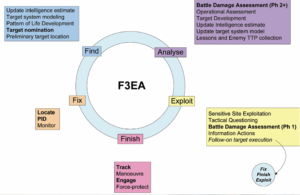
Figure 1. The F3EA concept represented as a cycle, with tasks and outputs of each stage defined. Bolded items are elements of the doctrinal targeting process. The exploit phase allows for an implicit branch to a second targeting operation, normally truncated to reflect opportunism.
Finish is the term describing the process by which targets are actioned to achieve the commander’s desired effect. During this phase a track is maintained on the target while execution assets are manoeuvred to engage the target. Engagement involves the execution of actions to create the desired target effect through kinetic or non-kinetic means.
Exploit describes the process by which opportunities presented by the target effect are identified and branch actions planned, often including the development of a follow-on targeting cycle. This phase includes Sensitive Site Exploitation (the collection of biometrics and physical samples of intelligence value from the target area and the investigation and documentation of the site), Tactical Questioning (gathering human information from persons in or around the target area), Battle Damage Assessment (the initial assessment and reporting of the quality of target effect and recommendations for re-attack), and Information Actions (to exploit the outcome of the finish phase and mitigate against operational risks that may arise due to collateral effects or adversary information actions). Information actions may take the form of messaging, leadership engagement, humanitarian, or other Psychological Operations or information operations capabilities.19
Analyse is that process within which detailed research and development is undertaken to restart the F3EA cycle, improve situational understanding, and improve own-system capability. This phase includes combat assessment (a detailed assessment of effects on the target system), operational assessment (an assessment of the outcomes of the operation in terms of the greater operational plan, producing recommendations for future target sets and apportioning of assets to meet changing operational requirements), and updating of the intelligence estimate and target system model. This phase also includes the development of new targets and may trigger a new targeting cycle. Finally, the analysis of own-force performance (lessons) and changes in adversary capability and effectiveness (enemy TTP) is completed to adapt own-force planning and counter possible future enemy actions.
Taken together, the find, fix, finish, exploit, analyse construct provides a method for dealing with high tempo operations against low-signature targets while focusing not only on the execution of the current target, but the generation of new targets. This recurrent action — based on the idea that, in modern warfare, complex systems often require some form of action in order to force target elements above the intelligence threshold — forms the point of difference between F3EA and earlier targeting paradigms.20
Characteristics of F3EA
The F3EA approach recognises that successful targeting in complex environments is heavily reliant on the exploitation of target and site information in order to facilitate follow-on targeting. It also recognises that the detailed analysis of such information will provide a greater understanding of the adversary and the environment.21 The F3EA approach thus closely follows the complex warfighting paradigm and espouses two key principles. The first of these maintains that exploitation and analysis, if not the main effort of the targeting process, are the components that keep the process cyclic.22 The second principle is that modern warfighters must constantly interact with the changing environment in order to learn at the rate demanded by successful targeting operations.23
F3EA utilises a double feedback loop (fast/slow) to handle targets emerging at different rates, or targets which require different levels of devel- opment.24 The departure from traditional dynamic targeting approaches is represented by the addition of the ‘fast’ loop, which speeds responsiveness of the targeting system to targets which emerge during or as a direct consequence of a targeting action. For example, tactical questioning of an insurgent may reveal the location of others resulting in the requirement to prosecute quickly while the information remains relevant. The ‘slow’ loop makes allowance for more traditional analysis-based target development and execution. This is described in Figure 2, where target development (which may take from days to months or years) is contrasted with the high tempo target execution component, which normally occurs very rapidly and can generate an entirely new target set that itself requires immediate, rapid execution.
F3EA assumes limited knowledge of the target (adversary or threat) system and thus relies not on a comprehensive model of the system during targeting, but rather on an emerging understanding of the system during recurrent F3EA cycles. Such intelligence-led targeting differs from operations-led targeting by the simple qualifier that the information feeding the targeting process is predominantly sourced from intelligence cells or ISR assets in real or near-real time.25
Michael T. Flynn, former intelligence chief for the International Security Assistance Force — Afghanistan, explains the current F3EA approach in the Afghanistan context with the observation that ‘exploit-analyze is the main effort of F3EA because it provides insight into the enemy network and offers new lines of operations.26 This concept aligns closely with the Australian Army’s ASDA construct which is designed specifically to counter low-signature adversaries.27 The assumption that most of the target system exists below the intelligence (detection or discrimination) threshold is matched with the hypothesis that, by perturbing the target system, some target elements must necessarily respond, thus providing a signature that can be detected, analysed, and turned into intelligence concerning the target system.
The Australian Army’s Adaptive Campaigning concept proposes ‘interaction with the problem’ as a key element of the planning and execution of operations in a complex environment.28 Interaction with the problem, through action, subsequent discovery and learning, allows the problem to be better defined (akin to the ‘slow’ F3EA loop) while behaviour is changed (representing an additional, slower loop that is not a component of targeting, but of planning). Changing the problem frame through iterative adaptive action and learning is a more general aspect of changing the adversary (target) frame through iterative action, exploitation and assessment in a targeting cycle. In this sense, the Adaptive Campaigning model can be viewed as a general operational level construct within which the F3EA targeting model neatly fits. The key difference is specificity of purpose: F3EA exists to neutralise or destroy an adversary, while Adaptive Campaigning exists to support general purpose land forces in the conduct of joint operations.
There has been increasing recognition of the requirement to maintain a reactive targeting capability across the services in both Australia and the US. The respective air forces have focussed on the ‘sensor-shooter’ link, reducing the system constraints on tempo for the find-fix-finish component of the cycle.29 This need to improve system capability to complete the targeting loop quickly is, to some degree, guiding future force design and capability acquisitions and partially explains the huge increase in non-traditional platforms.30
The F3EA model.
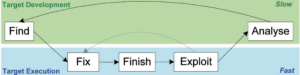
Figure 2. The F3EA model can be separated into two elements: target development and target execution. The full F3EA cycle can be truncated to incorporate just the ‘fast’ elements (fix, finish, exploit) in highly dynamic targeting environments where target exploitation immediately leads to the presentation of new targets.
F3EA in modern campaigns
The focus of contemporary dynamic targeting is insurgent network interdiction, specifically the targeting of high and medium value individuals. The targeting of individuals combines a classic low-signature, transient target with a high collateral effect risk and very high intelligence burden.31 The Bin Laden raid is an excellent example of such an operation.32 When coupled with a low force footprint and relatively low availability of collection, manoeuvre, and action assets, this has effec- tively pushed targeting elements into a paradigm which forces adversary systems to change and react to changes in the system.33 The discussion of current applications of F3EA in the next section is based on the assumption of these concepts.
The great strength of the F3EA model is the level of centralised control it affords through the use of organic assets.34 This approach also produces an inherent weakness, namely the huge consumption of resources — particularly ISR assets — and concentration of these resources in a targeting agency that may operate on only one of the multiple operation lines simultaneously occurring in a modern conflict. This ‘opportunity cost’ is a trade-off that must be considered when designing force structures and command and control arrangements in modern warfare.35
The detection of the target occurs in two parts: find and fix. Find includes the determination that a target exists and can be accessed. This phase includes deeper analysis to determine the location of the specific target under consideration within the larger target system. The fix phase aims to determine a time and location for target engagement while validating the target to enable the finish step to commence.
The assess function is similarly extended to include exploit and analyse.36 These two steps are linearly linked but maintain two different priorities. Exploit is concerned with immediate collection and analysis of information to enable rapid follow-on targeting and area effects to be generated. Analyse takes the informa- tion gained during exploitation, plus other sources of intelligence, to determine outcome effects, create new intelligence about targets or the environment, discover new targets for development, and share this information with other battlespace users. A further aspect of the analyse phase is self-analysis — the assessment of own-force performance and effects for the purpose of operational learning. The primary purpose of the exploit phase is to provide information-led operational branch options that may be pursued in line with command guidance.
Limitations of F3EA
In assessing the limitations of F3EA, it must be noted that this approach is not optimised for a conventional ‘first three days’ of warfare. In the early phases of conventional campaigns, targeting activities are largely driven by the operational level TSA, leaving little opportunity to dynamically engage or exploit target effects outside the fixed plan. Operation Odyssey Dawn, the 2011 Libyan interdiction, provides an illustrative example in which initial targeting focused on known counter-air and counter-sea infrastructure. Dynamic targets did not become a focus until the air defence system had been (at least partially) dismantled.37
F3EA may not be appropriate for conventional industrial targeting, apart from those occasions when dynamic targets occur. The concept of ‘exploit’ loses meaning in this context and becomes merely the first phase of analysis. In conventional targeting, a large proportion of time is spent in acquisition and tracking, while the ‘finish’ component is normally rapid. For example, the location and tracking of mobile air defence systems is taxing on ISR systems, with bomber aircraft held on standby; the finish is actioned as soon as a fix is achieved.
F3EA assumes a force structure and resource availability that is specific to forces designed for targeting — namely, significant ISR assets, a large analytical capability, and a rapid and highly reactive finish capability. This use of assets — organic or shared — is not necessarily the most efficient allocation across all lines of operation as an increase in effectiveness in finding and actioning targets comes at the cost of a sub-optimal resource allocation. This concept is well articulated by the US Asymmetric Warfare Group which observes that ‘the benefit of utilising F3EA … is that it refines the targeting process to identify and defeat specific indi- viduals. A potential down side to this approach is focussing critical collection assets on targets that are at the lowest level and not focussing assets against networks.’38
Current use of F3EA by the ADF is hamstrung by the lack of analytical capacity to fully implement the exploit and analyse phases. Contemporary operations are typified by the presence of ‘wicked’ problems, fitting the general definition of unknowable and un-testable, unique and ‘one-shot-only’ solutions.39 Targeting via the F3EA method is a direct and expedient method of treating these problems. However, without appropriate analytical capability, the application of F3EA may lead to the repetitive treatment of symptoms rather than allowing the systematic interdiction that targeting complex networks requires. In modern operations where forces are engaged in a race to learn and adapt, the risk is not only in being too slow, but also in learning the wrong things.
Conclusion
F3EA is the product of an evolution of traditional targeting concepts designed to allow targeting elements to compete with adaptable adversaries in complex environments. It is well suited to this particular challenge; when applied by appropriately enabled forces, F3EA has been shown to be highly successful.
The examination of F3EA and the way targeting framing has changed invites reconsideration of the purpose and desired outcomes of targeting actions. By embracing a construct that is inherently reactive such as F3EA, there is a tacit acknowledgement that our ability to understand the environment and the actors within it is insufficient to allow us to gain and maintain the initiative in contemporary conflict — contrary to the general aim of military targeting. This dilemma can be resolved with a reconsideration of purpose — the purpose of targeting in a complex environment should be to gain and maintain initiative within the conflict.
Where initiative requires understanding, learning is key. Targeting is used now not merely to neutralise threats or prepare the operational environment, but to learn about the adversary. Whereas learning had previously been a means to an end (to enable a strike), it is now an end in itself. What targeting achieves has changed, bringing opportunities and threats related to the dual outcomes. Targeting in a complex environment invites a tension between learning in order to affect and affecting in order to learn.
This highlights the difficulty of selecting targets and effects in an environment in which the true nature of a targeted system is unclear — or swiftly changing. Another view regards operations as an asset allocation problem, and the science of command as determining an allocation that can achieve multiple and sometimes conflicting priorities; in this sense, the F3EA representation simplifies the targeting problem.
Modern conflict requires a targeting philosophy that can respond very quickly to changes in the environment, maximise the collection and exploitation of available information, and maintain simultaneous streams of target development and execution at tempos dictated by adversary operations. Warfare against conventional adversaries will continue to leverage the efficiency and centrally prioritised effects at the joint operational level offered by the standard targeting approach.40 Future conflicts will use a combination of targeting approaches optimised to the types of warfare, forces, and adversaries within the conflict environment.41 Given the environment forecast in the Australian Army’s complex warfighting concept, F3EA will play a role in which dynamic and adaptable targeting actions are required.42 It now remains for doctrine and training to recognise and reflect the full potential of the F3EA approach.
Endnotes
1 For discussion of this concept, see R. Smith, The Utility of Force: The Art of War in the Modern World, Knopf publishing, UK, 2007.
2 M.T. Flynn, R. Juergens and T.L. Cantrell, ‘Employing ISR: SOF Best Practices’, Joint Force Quarterly, Third Quarter 2008, p. 56, retrieved on 7 December 2010 from http://www.dtic.mil/doctrine/docnet/courses/intelligence/intel/jfq_50_a…
3 Australian Defence Doctrine Publication (ADDP) 3.14, Targeting, Land Warfare Development Centre, Puckapunyal, 2009, para. 1-3.
4 Ibid., para. 1-4.
5 This concept of opportunity relates to the discovery mechanism of the target rather than to the importance (or necessity) of action against the target.
6 While abstract models can be considered as processes — taking inputs, transforming them, creating outputs — the idea of ‘process’ is too often tied to a rigid adherence to step-wise procedure; the concepts are separated here to avoid confusion.
7 US JP 3-60, Joint Doctrine for Targeting, 13 April 2007; ADDP 3.14, Targeting.
8 US FM 3-09.12 Tactics, Techniques, and Procedures for Field Artillery Target Acquisition, 21 June 2002.
9 D3A is used in deliberate targeting — targeting that will be planned when operational planning is underway. Dynamic targeting constructs are used when targeting must be planned during operational execution.
10 While the methods do not modify the steps of the targeting process, the method or approach frames the way the process is executed. See D.N. Propes, ‘Targeting 101: emerging targeting doctrine, Fires’, March 2009, retrieved from http://www.
thefreelibrary.com/Targeting+101%3A+emerging+targeting+doctrine.-a0200920409 on 7 December 2010.
11 The concept of dynamic targeting is largely artificial in the contemporary context, relating not to the properties of the target but instead to the way it is treated within the battle rhythm of a targeting force. The concept is more relevant to air operations (where processes are established to service a known target list) than land operations (which possess largely asynchronous targeting processes).
12 Specifically in ADF doctrine — ADDP 3.14 Targeting.
13 And ultimately the Laws of Armed Conflict.
14 That is, optimised for a centralised control, decentralised execution model as opposed to fully decentralised models favoured by land forces. See (US) Air Force Doctrine Document (AFDD) 2-1.9, Targeting, 8 June 2006.
15 B. Lambeth, Airpower against Terror: America’s Conduct of Operation Enduring Freedom, RAND Corporation Monograph, 2005.
16 Adaptive Campaigning 09 – Army’s Future Land Operating Concept, Directorate of Future Land Warfare, Canberra, 2009.
17 Political, military, economic, social, infrastructure, information.
18 Areas, structures, capabilities, organisations, people, events.
19 In ADF doctrine psychological operations are a component of information operations. See ADDP 3.13 Information Operations, Land Warfare Development Centre, Puckapunyal, 2006.
20 The intelligence threshold is a simplification of the ‘ISR threshold’ concept which recognises that targeting in the contemporary sense is led by intelligence which is a product of analysed information, and not by ISR data or information.
21 More importantly, the difficulty in separating the adversary from the environment
22 Flynn, Juergens and Cantrell, ‘Employing ISR’, pp. 56–61; W.J. Hartman, Exploitation Tactics: A Doctrine for the 21st Century, School of Advanced Military Studies Monograph, Fort Leavenworth, Kansas, 2008, p. 20.
23 J.D. Deeney, Finding, Fixing, and Finishing the Guideline: The Development of the United States Air Force Surface-to-Air Missile Suppression Force During Operation Rolling Thunder, Masters Thesis, US Army Command and General Staff College, Kansas, USA, 2010.
24 Either due to the complexity of the target or due to development that may have already occurred.
25 Real or near-real time as defined by the local commander on the basis of tactical developments or by operations using baseline (non-real time) intelligence.
26 Flynn, Juergens and Cantrell, ‘Employing ISR’.
27 Act-Sense-Decide-Adjust. See Adaptive Campaigning, p. 31.
28 Ibid., p. 33.
29 For a discussion of the concept of a ‘hunter-killer’ architecture for the USAF, see
D. Deptula and M. Francisco, ‘Air Force ISR Operations – Hunting versus Gathering’, Air and Space Power Journal, Winter 2010, pp. 13–17, at: http://www.airpower.au.af. mil/airchronicles/apj/apj10/win10/2010_4_04_deptula.pdf
30 Particularly armed unmanned aerial vehicles.
31 This includes the requirement to collect evidence of enemy or criminal activity to enable nomination of an individual as a target.
32 For details of the raid, see http://www.dailymail.co.uk/news/article-2021260/Osama-
Bin-Laden-Full-details-raid-catch-Al-Qaeda-leader-know-SEALs-identity.html accessed 20 February 2013, or the fictionalised account in the popular film Zero Dark Thirty.
33 Small footprints lead to discontinuous battlespaces where large areas within the terrain have little or no friendly force presence and can be considered non-permissive.
34 For an expansion of this concept in the Iraq context see W. Rosenau and A. Long, The Phoenix Program and Contemporary Counterinsurgency, Occasional Paper, RAND Corporation, 2009, at: http://www.rand.org/pubs/occasional_papers/2009/ RAND_OP258.pdf
35 Propes, Targeting 101: Emerging Targeting Doctrine usefully deconstructs the F3EA process for comparison with D3A.
36 Some proponents add disseminate to create F3EAD; dissemination can also be included in the analyse step.
37 Details of first-day targets are available via U.S. AFRICOM Public Affairs (20 March 2011). Overview of 1st Day of U.S. Operations to Enforce UN Resolution 1973 Over Libya. US AFRICOM, available from 19 Feb 13 at http://www.africom.mil/ NEWSROOM/Article/8097/overview-of-1st-day-of-us-operations-to-enforce-un
38 Attack the Network Part 1: Oil Spot Methodology, US Asymmetric Warfare Group, March 2009, retrieved on 10 December 2010 from: http://info.publicintelligence.net/ ArmyAttackNetwork1.pdf
39 For an introduction to ‘wicked’ problems, see H. Rittel and M. Webber, ‘Dilemmas in a General Theory of Planning’, Policy Sciences 4, Elsevier Scientific Publishing Co., Amsterdam, 1973, pp. 155–169.
40 In a ‘target rich’ environment.
41 For a discussion of the concept of hybrid warfare — a combination of asymmetric and conventional conflict — see F.G. Hoffman, ‘Hybrid Warfare and Challenges’, Joint Forces Quarterly, Issue 52, First Quarter 2009, pp. 34–39; M. Isherwood, Airpower for Hybrid Warfare, Mitchell Paper 3, Mitchell Institute for Airpower Studies, June 2009.
42 Or this role may be filled by an evolved version of the F3EA concept.
II. Task Force Orange is the commonly used name for the Intelligence Support Activity (ISA), a specialized unit within the U.S. Army. This unit plays a crucial role in military operations by focusing on intelligence gathering and support for special operations.
Key Functions
Primary Roles
Clandestine Human Intelligence (HUMINT): Collecting actionable intelligence through covert operations.
Counterterrorism Support: Assisting in missions aimed at neutralizing terrorist threats.
Operational Support: Providing intelligence and logistical support to other special operations forces.
Mission Scope
Task Force Orange operates under the Joint Special Operations Command (JSOC), working closely with elite units like Delta Force and SEAL Team 6. Its activities include:
Signals Intelligence (SIGINT): Intercepting communications and gathering electronic intelligence.
Surveillance: Conducting reconnaissance to gather information on high-value targets.
Historical Context
Formation and Evolution
Established: Originally formed as the Field Operations Group (FOG) in 1980, it transitioned to ISA in 1981.
Name Changes: The unit has been known by various names, including “The Activity” and “Army of Northern Virginia,” reflecting its secretive nature and diverse operational roles.
Notable Operations
Task Force Orange has been involved in several significant military operations, including:
Operation Name Year Description
Operation Winter Harvest 1981 Search for kidnapped General James L. Dozier.
Operation Red Dawn 2003 Intelligence support during the capture of Saddam Hussein.
Various JSOC Missions Ongoing Continuous support for counterterrorism efforts.
Conclusion
Task Force Orange remains one of the most secretive and vital components of U.S. military intelligence operations, specializing in preparing the battlefield for other special operations forces through intelligence collection and analysis.
III. Intelligence Support Activity
From Wikipedia, the free encyclopedia
Intelligence Support Activity
ISA emblem
Active 1981–present
Country United States of America
Branch United States Army
Type Special operations forces
Special mission unit
Role Clandestine HUMINT and covert action
Counterterrorism
ISTAR
Long-range penetration
Military intelligence
SIGINT
Special reconnaissance
Size Classified
Part of United States Special Operations Command
Joint Special Operations Command
United States Army Special Operations Command
Headquarters Fort Belvoir, Virginia
Nicknames The Activity, The Army of Northern Virginia
Motto “Send me” or Veritas omnia vincula vincit (“Truth overcomes all bonds”)
Engagements Operation Winter Harvest
Operation Prime Chance
Operation Desert Storm
Operation Gothic Serpent
Operation Joint Endeavor
Operation Enduring Freedom
Operation Iraqi Freedom
Operation Inherent Resolve
Decorations Presidential Unit Citation
Joint Meritorious Unit Award
Superior Unit Award[1]
Commanders
Current
commander Classified
Notable
commanders Jerry King
Michael K. Nagata
Richard E. Angle
The Intelligence Support Activity (ISA), also known at various times as Mission Support Activity (MSA), Office of Military Support (OMS), Field Operations Group (FOG), Studies and Analysis Activity (SAA), Tactical Concept Activity, Tactical Support Team, Tactical Coordination Detachment,[2] and also nicknamed “The Activity” and the “Army of Northern Virginia”,[3] is a United States Army Special Operations unit which serves as the field military intelligence gathering component of Joint Special Operations Command (JSOC).[4][5][6] Within JSOC, the unit is often referred to as Task Force Orange.[7][8][9]
Originally subordinated to the United States Army Intelligence and Security Command (INSCOM), it is one of the least known intelligence components of the United States military,[7] tasked with clandestine human intelligence operations and collecting actionable intelligence during or prior to JSOC missions.[10]
The Activity and its counterparts the Regimental Reconnaissance Company (RRC), Delta Force, DEVGRU, and the 24th Special Tactics Squadron (24th STS) are the U.S. military’s special mission units, performing the most complex, classified, and dangerous missions as directed by the National Command Authority.[7]
The unit is known by many names. USAISA was the official name of the unit from 1981 to 1989. It has also gone by a number of two-word special access program names, including OPTIMIZE TALENT, ROYAL CAPE, CENTRA SPIKE, CAPACITY GEAR, GRANTOR SHADOW, TORN VICTOR, QUIET ENABLE, OPAQUE LEAF, CEMETERY WIND, GRAY FOX, TITRANT RANGER, and INTREPID SPEAR.[2][3][11][12]
History
Field Operations Group
The Field Operations Group (FOG) was created in the summer of 1980 in order to take part in a second attempt to rescue the U.S. hostages held in the Tehran embassy after the failure of the Operation Eagle Claw. That operation had highlighted the U.S. shortfall in intelligence gathering.[13][14]
The Field Operations Group was under command of Colonel Jerry King and operated in Iran, accomplishing various covert intelligence gathering missions. The work accomplished by the FOG was successful, however the second attempt (called Operation Credible Sport) never took place because the air assets needed were not available.[12][15]
After the cancellation of Operation Credible Sport, the FOG was not disbanded but enlarged. The administration saw ground intelligence contingencies as needing improvement if future special operations were to be successful, as the Central Intelligence Agency (CIA) did not always provide all the information needed. So, on 3 March 1981, the FOG was established as a permanent unit and renamed US Army Intelligence Support Activity (USAISA).[12] This ISA should not be confused with a later unit known as the Ground Intelligence Support Activity (GISA), which was subordinated to the Army G2.
Badge and insignia
The current badge depicts an American bald eagle grasping a claymore, surrounded by a kilt belt, inscribed with the Latin phrase “Veritas Omnia Vincula Vincit” (“Truth Overcomes All Bonds”). In the original crest, the claymore was wrapped in a chain with one of the links broken as a reminder of those killed during the failed Operation Eagle Claw. This symbol of failure was later deemed no longer appropriate.
The badge was deliberately designed by Jerry King and other founding members of the unit because of their shared Scottish heritage. The claymore is a greatsword originating from the Scottish Highlands, and the belt surrounding the badge is seen on Scottish clan badges (the belt signifies that the wearer is a member rather than the chief of the clan – the chief wears the badge without a belt surround).
U.S. Army Intelligence Support Activity
Build-up
In 1981 the Intelligence Support Activity began to immediately select new operators, growing from the FOG’s original 50 members to about 100. The ISA remained extremely secret; all of its records were classified under a Special Access Program initially named OPTIMIZE TALENT. The ISA was given its classified budget of $7 million, a secret headquarters in Arlington, Virginia, and cover name, the Tactical Concept Activity.[12] ISA included three main operations branches (Command, SIGINT and Operations) and an analysis branch, whose name changed over the years (e.g. Directorate of Intelligence, Directorate of Intelligence and Security).[16][17] Colonel Jerry King became the ISA’s first commander.[12][18][19]
The ISA’s mission was to support United States special operations forces (primarily Delta Force and DEVGRU) in counterterrorism and hostage rescue operations and other special operations units. The ISA would provide actionable intelligence collection, pathfinding, and operational support. The ISA performed several operations mainly in Latin America and the Middle East during the 1980s, but also in East Africa, South-East Asia, and Europe.[12] The current organization of ISA is classified but does contain at least three squadrons (Operations, SIGINT and Mission Support/Communications).[16]
First missions
The ISA conducted various missions, including giving protection to the Lebanese leader Bachir Gemayel and attempting to buy a Soviet T-72 tank from Iraq (a deal that was finally stopped by the Iraqis).[12][20]
Dozier kidnapping, Operation Winter Harvest
On 17 December 1981, the senior U.S. Army officer in NATO Land Forces Southern European Command, Brigadier General James L. Dozier, was kidnapped from his apartment in Verona, Italy, by the Italian Red Brigades terrorist[21][22][23][24][25] organization. The search for General Dozier saw a massive deployment of Italian and U.S. forces, including thousands of Italian national police, the Carabinieri. The search also featured some unconventional participants, including “remote viewers” from Project Stargate and an international cast of psychics, largely orchestrated by General Albert Stubblebine, then-Commander of United States Army Intelligence and Security Command (INSCOM), and a great believer in the use of unconventional intelligence gathering methods. An ISA SIGINT team was sent to Italy as part of Operation Winter Harvest and in conjunction with other Army SIGINT and counterintelligence units, employed aerial and ground-based SIGINT systems to monitor and geo-locate terrorist[26][27] communications.[28] ISA and the other Army elements provided useful intelligence, helping Italian police to arrest several Red Brigades members in mid-January 1982. The Italian police and intelligence agencies have never officially disclosed how they located General Dozier in late January 1982. However, U.S. Army participants in the operation have hinted that the mid-January arrests, the interrogation of those arrested, and follow-on investigations led to the eventual location of the Red Brigades hideout where Dozier was being held, in an apartment over a store in Padova. There is little doubt that the successful outcome resulted in part from the contributions of ISA’s SIGINT specialists and the other supporting Army intelligence elements. General Dozier was freed unharmed by NOCS operators, also known as “The Leatherheads” for their unique headgear, on 28 January 1982.[12]
Operation Queens Hunter
In early 1982, the ISA was needed to support a SIGINT mission in El Salvador, a mission that the Central Intelligence Agency (CIA), the National Security Agency (NSA), and United States Army Intelligence and Security Command (INSCOM) were not able to accomplish. The task was submitted to the United States Army Special Operations Division (SOD), which started Operation Queens Hunter. Operating from a Beechcraft model 100 King Air flown by SEASPRAY (a clandestine military aviation unit) based in Honduras, ISA SIGINT specialists monitored communications from Salvadoran guerrilla death squads, providing intelligence which helped the Salvadoran Army defend against guerrilla attacks. The success was such that the operation, planned to last a month, ran for more than three years. More aircraft were deployed, and eventually included eavesdropping on Honduran guerrillas too, as well as Nicaraguan Army units fighting against the Contras.[12]
The POW/MIA affair
The ISA has also conducted an operation to search for US MIAs (soldiers reported as Missing In Action) allegedly held in South-East Asia in secret POWs camps in the 1980s. In 1979, U.S. intelligence thought it had located a POW camp in Laos using aerial and satellite photographs. A ground reconnaissance was needed to determine if people seen on photographs were really American POWs. At the same time, former Special Forces Lieutenant-Colonel James G. “Bo” Gritz planned a private rescue mission with other S.F. veterans. Having informed the U.S. government officials about the mission, Gritz was first told to abort his “mission,” but was eventually approached by the ISA. Nonetheless, Gritz was not believed to be doing serious work, and Pentagon officials ordered the ISA to terminate their relationship with him when they discovered that ISA had provided him with money and equipment.[12]
In 1989, the then USAISA commander John G. Lackey sent a telex “terminating” the USAISA term and his special access program GRANTOR SHADOW. Colonel John Lackey served as unit commander from 1986 to 1989.[29] However, the unit continued under a series of different Top Secret codenames which are changed every two years. Known codenames included CAPACITY GEAR, CENTRA SPIKE, TORN VICTOR, QUIET ENABLE, CEMETERY WIND, and GRAY FOX.[3]
Gray Fox
Gray Fox was the codename used by the ISA at the beginning of the War in Afghanistan. Its members often worked closely with Joint Special Operations Command and the Central Intelligence Agency (CIA).[30]
In 2002, Gray Fox operators served alongside Delta Force and DEVGRU in the mountains of Afghanistan.[31] Gray Fox intercepted enemy communications and trekked to observation posts with special operations units. They also supported the conventional forces of the 10th Mountain Division and 101st Airborne Division in fighting near Takur Ghar in Afghanistan’s Shahikot Valley during Operation Anaconda.[citation needed]
The unit helped spearhead the search for Saddam Hussein and his family after the U.S.-led invasion of Iraq in 2003. Gray Fox operatives sometimes work under the broader umbrella of “Joint Special Operations Task Force 20”, which also included DEVGRU, the Army’s Delta Force, and 160th Special Operations Aviation Regiment. Saddam Hussein was eventually captured during Operation Red Dawn.[30]
Under Joint Special Operations Command
In 2003, the Intelligence Support Activity was transferred from the Army INSCOM to Joint Special Operations Command, where it was renamed the Mission Support Activity.[30]
Since 2005 onward, the ISA has not always operated under a two-worded Special Access Program (SAP) name (GRAY FOX, CENTRA SPIKE, etc.). In 2009, the unit was referred to as INTREPID SPEAR, until this was revealed to have been leaked in an email to the Pentagon.[30] In 2010 it was referred to as the United States Army Studies and Analysis Activity.[30]
Elements of the former ISA assisted in intelligence collection and analysis operations prior to and during the 2 May 2011 U.S. Special Operations Forces mission which resulted in the death of Osama bin Laden. Elements of DEVGRU, along with the ISA, members of the CIA Special Activities Division, DIA,[32] and the NSA combined to execute a raid in Abbottabad, Pakistan, which ultimately killed bin Laden and resulted in the deaths of several family members and associates.
Recruitment, training, and organization
According to Sean Naylor in Not a Good Day to Die, most (but certainly not all) Activity operatives come from United States Army Special Forces, due to their self-reliance and specialized skill-set.[31] Candidates also come from the other military branches. Most candidates assigned to the Operations, Communications, and/or SIGINT squadrons go through an assessment and selection course, as well as a lengthy background investigation and psychological testing. Once admitted, they receive further training in a specialized Training Course. Like all units, the Intelligence Support Activity contains operational detachments as well as support detachments such as intelligence analysis, medical, logistics.[17]
HUMINT and SIGINT
Foreign language skills, although highly desired, are not a prerequisite to becoming a member of the ISA, though to be a SIGINT/HUMINT operator in the field with other Special Mission Units, working clandestine operations in non-permissive environments, knowing a minimum of several languages is usually indispensable (e.g. Persian, Arabic, Pashto etc.).
Some of the disciplines focused on in the training course are infiltration techniques, advanced air operations, professional driving (offensive and off-road), personal defensive measures, use of state-of-the-art communications equipment, deep surveillance, tradecraft, weapons handling, hand-to-hand combat, signals intelligence, etc.
See also
Other Intelligence-based special operations units:
13th Parachute Dragoon Regiment, a similar unit of French army special forces
Special Reconnaissance Regiment, a similar unit in the United Kingdom Special Forces.
Sister JSOC units:
1st Special Forces Operational Detachment – Delta
24th Special Tactics Squadron
Naval Special Warfare Development Group
75th Ranger Regimental Reconnaissance Company
References
General and cited references
Bowden, Mark (2001). Killing Pablo: The Hunt for the World’s Greatest Outlaw. New York: Atlantic Monthly Press. ISBN 978-0-87113-783-8.
Emerson, Steven (1988). Secret Warriors: Inside the Covert Military Operations of the Reagan Era. New York: G.P. Putnam’s Sons. ISBN 978-0-399-13360-2.
Richelson, Jeffrey T. (1999). “Truth Conquers All Chains: The U.S. Army Intelligence Support Activity, 1981–1989”. International Journal of Intelligence and CounterIntelligence. 12 (2): 168–200. doi:10.1080/088506099305133. ISSN 0885-0607 – via InformaWorld.
Jeffrey T. Richelson, 23 May 2001, “The Pentagon’s Spies: Documents Detail Histories of Once Secret Spy Units”, electronic book by on the National Security Archive website (Archived). The article collects copies of declassified documents about covert US military intelligence units, including the ISA:
Memorandum for Director, Defense Intelligence Agency, by Lt. Gen. Philip C. Gast, USAF, 10 December 1980
Memorandum to the Deputy Under Secretary for Policy, by Frank Carlucci, 26 May 1982
Charter of U.S. Army Intelligence Support Activity, circa mid-1983
After Action Report for Operation CANVAS SHIELD, by 902nd Military Intelligence Group, 30 July 1985
Brief History of Unit (ISA), circa mid-1986 (presumed)
United States Army Intelligence Support Activity 1986 Historical Report
United States Army Intelligence Support Activity 1987 Historical Report
Termination of USAISA and “GRANTOR SHADOW”, by Commander, USAISA, 31 March 1989
Smith, Michael (2006). Killer Elite: The Inside Story of America’s Most Secret Special Operations Team. New York: St Martin’s Press. ISBN 978-1-250-00647-9. (Several editions from 2006 to 2011 with additional material.)
References
Army General Orders Unit Awards Index (PDF), US Army, 13 October 2015
Gray, Warren (20 June 2020). “The Guns of Delta Force”. Gunpowder Magazine. Archived from the original on 21 June 2022. Retrieved 24 August 2022.
Naylor, Sean (2016). Relentless Strike: The Secret History of Joint Special Operations Command. St. Martin’s Publishing. ISBN 978-1250105479.
“Joint Special Operations Command (JSOC)”. GlobalSecurity.org. Archived from the original on 18 July 2022. Retrieved 28 February 2021.
Neville, Leigh (2008). Special Operations, Forces in Afghanistan. Library Genesis. Oxford; New York: Osprey Publishing. ISBN 978-1-84603-310-0.
Gellman, Barton (23 January 2005). “Secret Unit Expands Rumsfeld’s Domain”. The Washington Post. Archived from the original on 24 July 2008. Retrieved 28 February 2021.
Ambinder, Marc (22 March 2013). “The Most Secret of Secret Units”. The Week. Archived from the original on 3 August 2022. Retrieved 28 February 2021.
Naylor, Sean D. (1 May 2015). “Meet the Shadow Warrior Leading the Fight Against the Islamic State”. Foreign Policy. Archived from the original on 6 September 2015. Retrieved 28 February 2021.
Hand IV, George (18 December 2019). “Task Force Orange: Supporting Delta Force”. SOFREP. Archived from the original on 19 August 2022. Retrieved 28 February 2021.
“Prepared Statement to be Given by MG William E. Odom, Assistant Chief of Staff for Intelligence, Department of Army Before the House Permanent Select Committee on Intelligence on 8 June 1982” (PDF). 8 June 1982. Archived from the original (PDF) on 16 September 2021. Retrieved 24 August 2022.
Richelson, Jeffrey T. (23 May 2001). “The Pentagon’s Spies”. National Security Archive. Archived from the original on 31 January 2022. Retrieved 24 August 2022.
Richelson, Jeffrey (1 June 1999). “‘Truth Conquers All Chains’: The U.S. Army Intelligence Support Activity, 1981–1989”. International Journal of Intelligence and CounterIntelligence. 12 (2): 168–200. doi:10.1080/088506099305133. ISSN 0885-0607.
“Memorandum for Director, Defense Intelligence Agency” (PDF). 10 December 1980. Archived from the original (PDF) on 8 June 2021.
Clancy, Tom (2001). Special Forces. New York: Berkley Books. ISBN 978-0-425-17268-1.
“Brief History of Unit” (PDF). Archived from the original (PDF) on 17 October 2021.
“United States Army Intelligence Support Activity 1986 Historical Report” (PDF). Archived from the original (PDF) on 11 November 2001.
“United States Army Intelligence Support Activity 1987 Historical Report” (PDF). Archived from the original (PDF) on 11 November 2001.
“COLONEL JERRY M. KING” (PDF). Archived from the original (PDF) on 17 July 2017. Retrieved 17 July 2017.
Wilson, George C. (23 August 1983). “Secret Army Intelligence Unit Lived On After 1980 Iran Mission”. The Washington Post. Archived from the original on 9 June 2022. Retrieved 24 August 2022.
Hersh, Seymour M. (22 November 1987). “Who’s In Charge Here?”. The New York Times. Archived from the original on 28 December 2021. Retrieved 24 August 2022.
Orsini, Alessandro; Nodes, Sarah J. (2011). Anatomy of the Red Brigades: The Religious Mind-set of Modern Terrorists (1 ed.). Cornell University Press. ISBN 9780801449864. JSTOR 10.7591/j.ctt7zft3.
“Red Brigades”. Mapping Militant Organizations. Stanford University. June 2018. Archived from the original on 13 August 2023. Retrieved 13 August 2023.
Sundquist, Major Victor H. (2010). “Political Terrorism: An Historical Case Study of the Italian Red Brigades”. Journal of Strategic Security. 3 (3): 53–68. doi:10.5038/1944-0472.3.3.5.
Wagner-Pacifici, Robin. The Moro Morality Play: Terrorism as Social Drama. Chicago, IL: University of Chicago Press.
“”Years of Lead” — Domestic Terrorism and Italy’s Red Brigades – Association for Diplomatic Studies & Training”. adst.org. March 2016. Retrieved 2 January 2025.
Drake, Richard (1999). “Italy in the 1960s: A Legacy of Terrorism and Liberation”. South Central Review. 16/17: 62–76. doi:10.2307/3190077. ISSN 0743-6831. JSTOR 3190077.
sso.sagepub.com https://sk.sagepub.com/ency/edvol/terrorism2ed/chpt/red-brigades. Retrieved 2 January 2025. {{cite web}}: Missing or empty |title= (help)
“The Red Brigades: A Primer” (PDF). Archived from the original (PDF) on 22 March 2023.
“COLONEL JOHN G. LACKEY III” (PDF). Archived from the original (PDF) on 27 December 2016. Retrieved 27 December 2016.
Ambinder, Marc; Grady, D. B. (2012). The Command: Deep Inside the President’s Secret Army. Hoboken: John Wiley & Sons. ISBN 978-1-118-34672-3. OCLC 778339638.
Naylor, Sean (2005). Not a Good Day to Die: The Untold Story of Operation Anaconda. New York: Berkley Books. ISBN 978-0-425-19609-0. OCLC 56592513..
“Army Regulation 690–950–4 Military Intelligence Civilian Excepted Career Program” (PDF). Headquarters, Department of the Army. Archived from the original (PDF) on 2 August 2022.